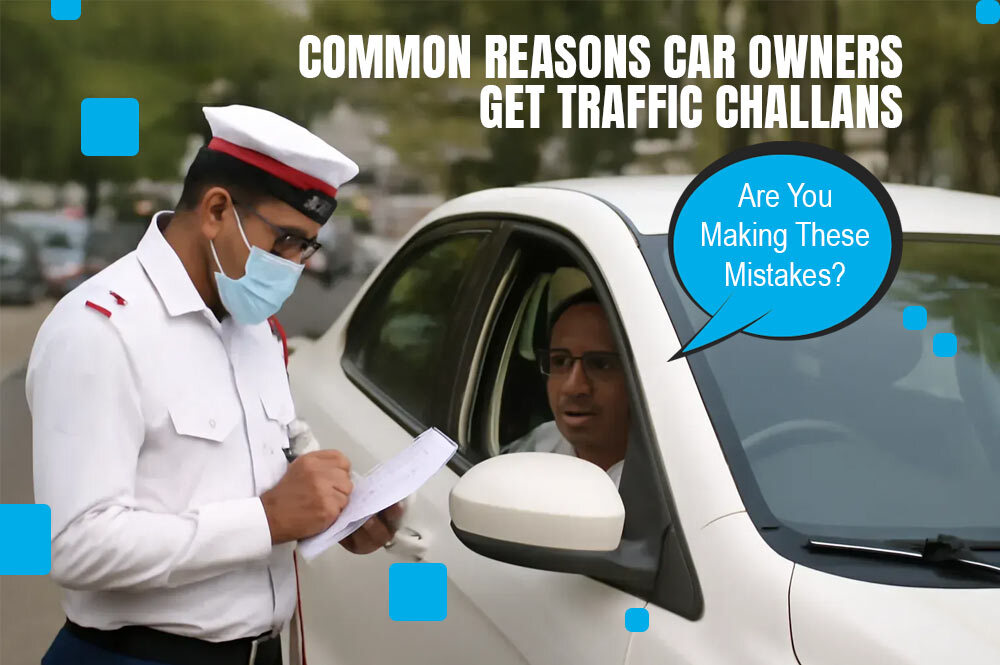
Common Reasons Car Owners Get Traffic Challans Are You Making These Mistakes?
Soumi Roy 31-01-2026

Check Vehicle Owner Details @ ₹199*
Avoid fraudulent used car details! | Buy used cars with high market value | Ensure the used car justifies its price
Table Of Content
India has one of the most extensive sets of rules for car owners and drivers. If you think you will receive a challan only for breaking a signal or driving without proper documents, you are far from reality. Most challans are issued for minor mistakes that even the most careful owners tend to miss.
With stricter rules and improved surveillance across roadways, it has become nearly impossible to escape violations without penalties. Below are some common mistakes that drivers knowingly or unknowingly make, for which a traffic police officer may issue a challan.
Not Using a Seatbelt in the Backseat
A common myth among Indian citizens is that only the driver or front-seat passengers need to wear seatbelts. However, this is far from the truth. The Motor Vehicles Act mandates that every individual in a car must wear a seatbelt. Failure to comply can result in a challan up to ₹1,000 depending on the state enforcement.
Using Mobile Phones Even at Red Lights
Under the amendment of Motor Vehicles Act, it is illegal to operate mobile phones or other electronic devices while driving, even at a red signal. Drivers may be subjected to a fine of up to ₹5,000. Only mounted phone holders used for GPS navigation and voice-controlled commands are permitted.

Parking in Prohibited Areas
If you believe that a place without a “No Parking” sign is a safe parking spot, you are mistaken. Many areas are now digitally marked, enabling traffic police to use GPS data and zone records to issue challans. Parking is also prohibited near U-turns, intersections, and pedestrian crossings. Drivers should use smart-city parking apps, official traffic police apps, or electronic signage to identify no-parking zones.
Not allowing an emergency vehicle to pass.
Emergency vehicles such as ambulances, fire trucks, and other government-designated vehicles are permitted to cross red lights when responding to emergencies. Blocking their path using a privately owned vehicle, whether intentionally or unintentionally is a traffic violation. Under Section 194E of the Motor Vehicles Act, deliberately obstructing an emergency vehicle can result in a ₹10,000 fine and in extreme cases, imprisonment for six months. Drivers should remain alert and avoid blocking intersections at all times.
Carrying Expired or Missing Documents
Carrying valid vehicle and personal documents is as important as following traffic rules. Driving with expired or invalid documents, including insurance papers, can result in heavy penalties. According to the updated rules regarding missing or expired documents, the following punishments apply:
Missing or invalid driving license/registration certificate: ₹5,000 for the first offense (penalties may increase for repeat violations)
Missing or invalid Pollution Under Control (PUC) Certificate: ₹10,000, along with possible imprisonment or community service
However, if valid documents are produced within seven days of the challan being issued, the fine may be reduced to ₹100.
Owners or drivers should take the following steps to ensure safety:
- Set reminders of document expiry
- Use government-approved digital copies because these are accepted by both the court and police.
- Carry both digital and physical copies of your documents.
- Check your document status on the Parivahan or VAHAN portal.