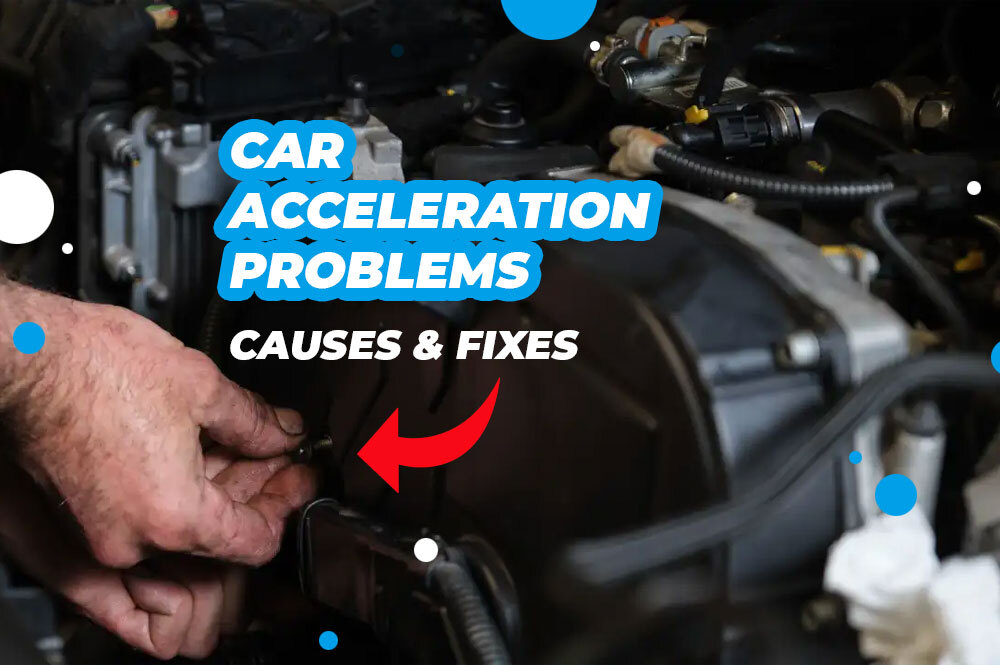
Why Cars Develop Acceleration and Pickup Problems: Causes, Fixes, and the Importance of Vehicle History Report
Soumi Roy 28-04-2026

RTO Vehicle Details In Seconds! @ ₹199*
Get Complete Vehicle Ownership History | Registration Year | Make, Model & More!
Table Of Content
Have you ever been in a situation when you are about to rush to a hospital and your car almost gives up?
The common problems of used cars are often mechanical issues. Those issues could be passed on from the previous owner. In case such issues appear when you are driving the car, you have no other option than taking the car to its authorized service center.
The technicians use computers to detect the DTCs (Diagnostic Trouble Codes) to identify the issue and mend them.
The problems of acceleration and pickup could be a little complicated. The error may not be recorded in the DTC and the technician may need to conduct a thorough manual inspection to find out the fault.
These hassles can be avoided. If the buyer can decide about buying a used car based on Reports on Vehicle History generated by the CarCheck feature of AutoHealth.
Common Acceleration And Pick-Up Problems in Cars
Common acceleration problems may not be detected by the Electronic Control Unit (ECU) of the car. In this scenario, the scanner plugged into the On-Board Diagnostic - II (OBD-II) of the car may not show any Diagnostic Trouble Codes (DTC). The technician may need to find the issue through a time consuming manual process.
Reasons :- There can be a few reasons that can affect the acceleration and pick-up of a car. They can be listed as follows:
Fuel System Issues - A few types of fuel system issues can be listed as the followings-
- Clogged Fuel Filter/ Pump
- Dirty Fuel Inejectors
Inadequate fuel delivery diminishes the acceleration, often at high speed. Improper spray of fuel because of choked injectors reduces acceleration, too.
Air Intake System - Air system issues that diminishes the acceleration are the followings -
- Clogged/ Dirty Air Filters - low airflow to the engine slows down the acceleration.
- Vacuum Leaks - unmetered flow of air into engine ruins the air - fuel mixture and impacts the acceleration.
Ignition System - The issues include the followings -
- Worn Spark Plugs - often resulting in engine misfires giving into jerking and hesitation at the time of acceleratio
- Malfunctioning ignition coil - leads to weak sparks and subsequent problems of acceleration
Sensor and Electronic Failure - This issue can lead to the following situations -
- Dirty Mass Air Flow (MAF) Sensor - leads to misreading of air intakes which makes the computer miscalculate the amount of fuel needed.
- Throttle Position Sensor (TPS) - makes jerking or sluggish response when the accelerator is pressed
Exhaust and Emission System - This issue is seen in clogged catalytic converters building up exhaust gases that chokes the engine ending up in extreme loss of power
Transmission and Mechanical Issues - These issues include the followings -
- Transmission Issues -resulting in high RPM without increase in speed because of low transmission fluid, slipping gears or delayed shifting
- Dragging Brakes - resistance from slipping brake clippers.
Contents of Vehicle History Report
All the pain of facing acceleration and pick-up problems could be avoided, if the current owner could have checked the vehicle history report through the CarCheck feature of AutoHealth. General contents of the Vehicle History report are as follows :
- Car Information - includes Make, Model, Color, Year of Manufacturing, Fuel Type of the car, Status (Active or deactivated) of the registration certificate, Registration authority, Address of the car, Engine size, number of cylinders, Fuel type, Body Type, Seating, Wheelbase, Vehicle Weight, Unladen Weight, Emission Norms, Vehicle Category
- Owner Information - includes Name of the owner, registration number of the car, Year of registration, Expiry date of registration, Engine number, Chassis Number, Insurance company name, Validity period of insurance, Status of Pollution Control Certificate, Vehicle Ownership type, Address of the Owner
- Outstanding Payments to the Authorities - includes Number of Total Challan against the car’s registration plate number, Number of Pending Challan, Total Amount of Dues, Backlist status, Date of Most recent payment of Challan, Backlist Details
- Legal Compliance Status- include Insurance Status, Status of Pollution Under Control, Validity of registration certificate, Vehicle Tax, Emission Norm, Recall
- Service History - the most important information with respect to the current scenario of mechanical failure of the car’s acceleration and pick-up systems. The details that are covered in this part of the report are -
- Total Number of Services
- Last OdometerReading
- Servicing Trend
- Last Service
- Major Expenses
- Dealer Servicing
- Accident History - includes the details like if the car was in an accidents, Types of accidents, Estimated cost, Accident Status, Date of Accident
- Services and accident history timeline - this item of information is also very important to get to the bottom of the problem of acceleration and pick-up and any mechanical problem of the car. This category of information includes the latest 10 service records, scheduled maintenance and accident repairs, Accident repairs are detailed in this section of the report.
How Vehicle History Report Can Help Know If a Used car has an Acceleration Problem
If you check the vehicle History Report of a used car at AutoHealth, then you will see the details of maintenance history in the report. In other words, whenever the used car gets servicing, the details of the servicing gets included in the car service history of the car.
The CarCheck Report of AutoHealth gives car service history as part of the Vehicle History Report. Hence, AutoHealth can be your used car buying guide.
FAQ
What is DTC?
DTCs (Diagnostic Trouble Codes) are standardized alpha-numeric codes generated by a vehicle's OBD-II system when there is a malfunction in systems (e.g., engine, transmission, emissions) of the car. When any fault occurs, the computer, the car’s ECU, records the code for the fault and turns on the check engine light. The lights help the technicians to identify the exact problem e.g., misfires, sensor errors, emission faults, fault at fuel pressure regulator et cetera. Often technicians attach a reader to OBD - II of vehicles to read the ECU data so that they get the exact error code
What should you do if your car has an acceleration and pick up problem?
It is always better to take the car to an authorized service service center in case any fault occurs in your car. If a car has acceleration and pick-up problems then you must take the car to an authorized service center.
Why can Autohealth be a used car buying guide?
The CarCheck feature of AutoHealth generates a holistic report on the car, on the ownership of the car, the status of insurance and the duration of the registration certificate of the car. This report also reveals the maintenance as well the maintenance due to accidents, as part of the car’s history. All the information in the Vehicle History Report about a car comprises a complete history of the used car. Because of the CarChek report of AutoHealth, AutoHealth can be the best used car buying guide.